
A $4 KitKat and the quiet logic of airport retail
Global travel retail is moving more people than ever, and spending less per head. Hamad International moved past five million passengers in a single month for the first time in 2025. But Kearney’s numbers put average spend per traveller at around $15.50, down from a $24.30 peak. More feet, smaller baskets — most of us running these businesses feel that tension directly.
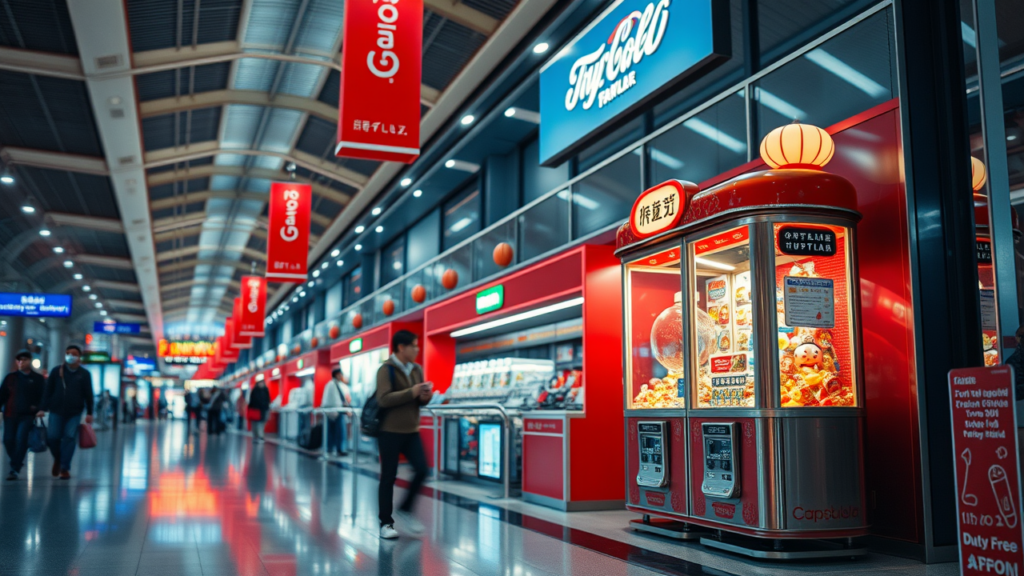
Which is why a small KitKat activation at Hamad this August is worth a closer look. Qatar Duty Free and Nestlé built a “Taste of Japan” experience across three of the terminal’s busiest nodes: matcha, blueberry cheesecake, Tokyo Shima lemon, and a dark-chocolate “adult sweetness” range you can’t find elsewhere. Bold red gondolas, Japanese street-market visuals. Nice, but not by itself the interesting part.
The interesting part is the mechanic. Buy any two KitKats and you get a token for a Gachapon machine — the capsule-toy dispensers that are a genuine cultural ritual in Japan. Drop in the token, turn the knob, and out comes an exclusive collectible. A four-dollar chocolate turns into a small moment worth talking about to the person next to you on the plane.
It works because it quietly changes the maths. The “buy two to play” gate nudges units per transaction up, and the machine itself pulls people in — they linger, they watch, they queue, they post. A low-involvement confectionery aisle becomes a discovery loop: browse, buy, play, leave with a keepsake. That’s retail theatre for the cost of a capsule toy.
Nestlé isn’t treating this as a one-off. They ran the same concept at Singapore Changi in May, with the same flavours and the same capsule mechanic, framed as the first step in a wider rollout. Fred Porchet, their GM for international travel retail, put it plainly: travellers increasingly want things that “feel exclusive, culturally distinctive and giftable,” and the goal is to make Taste of Japan “a true travel retail phenomenon that keeps travellers coming back to discover what’s new.” That reads as a platform, not a poster.
There’s a second layer that’s easy to miss. The localization runs both ways. QDF brings Japan to Doha, but it also exports its own identity — the same cultural-reciprocity idea showed up in a Qatar-exclusive POP MART drop. The airport becomes a curator, not just a shelf.
So for brand managers at other houses: you don’t need a luxury budget to borrow from this. You need a cheap, repeatable mechanic that turns a purchase into a memory, and a flavour or a story that feels worth sharing. Confectionery is a good test bed — low risk, high giftability. Build it once, swap the culture per route, and there’s a global platform hiding inside a four-dollar bar.